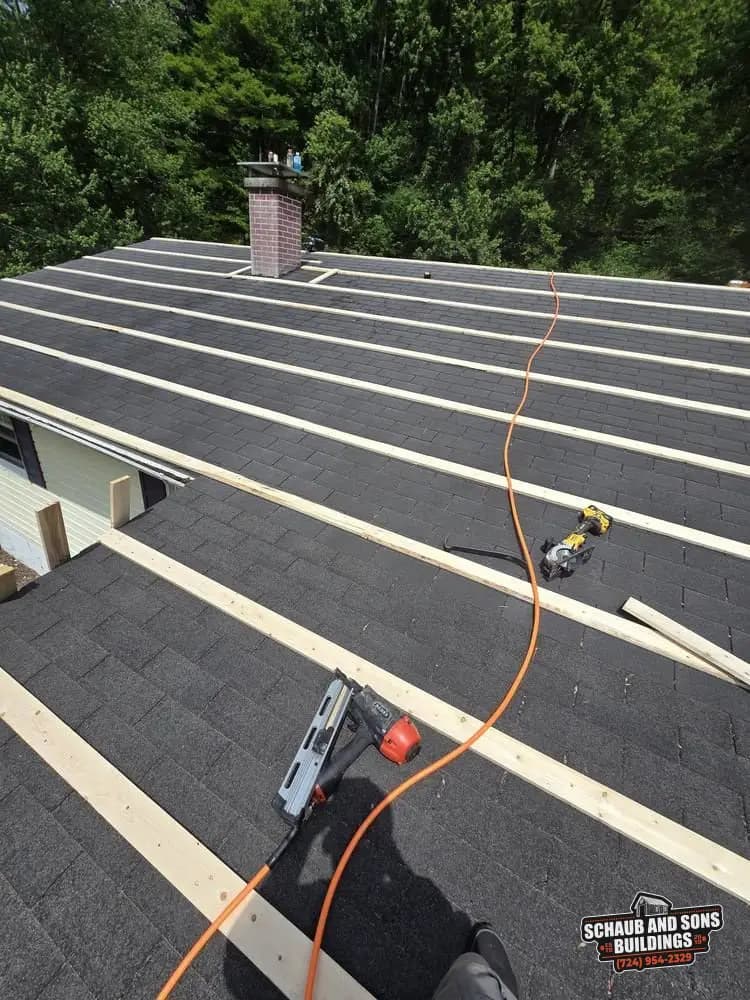
Metal over shingles: how it works
Metal Roofs · 6 min read ·
A metal roof over shingles leaves the old shingles in place, adds rows of wood battens on top, and fastens the metal panels to those battens. No tear-off, no dumpster full of old roofing, and the house stays covered the whole time.
The old roof becomes the base
When the shingles are flat and the deck under them is solid, there is often no reason to strip them. The existing roof stays put and works as one more layer between the weather and the house. What changes is what sits on top.
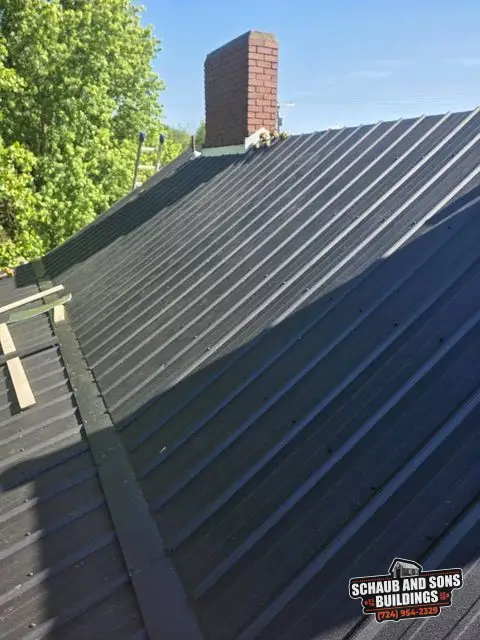
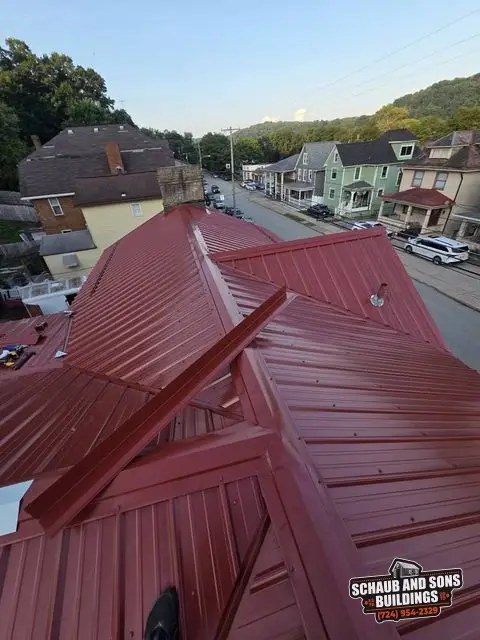
We did this three times in May and June 2026, on a black roof, a gray roof and a red roof. Each one started the same way, and each one finished with metal from eave to ridge over the original shingles.
Why battens go down first
Metal panels need something solid and even to screw into. Shingles alone are soft and lumpy, so we fasten wood battens (some crews call it strapping) in rows across the roof, from the eaves up toward the peak. The panels then fasten to wood, not to old asphalt.
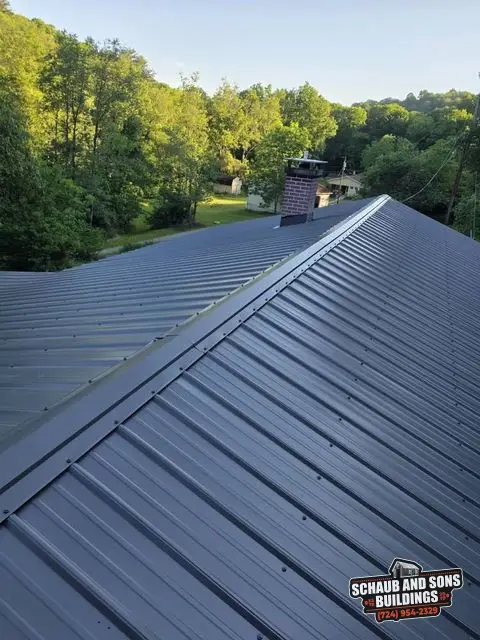
On the gray metal-over-shingle job the hero photo above shows exactly that stage: fresh battens in straight rows over dark shingles, worked right up around the brick chimney. The battens also lift the metal a little off the old roof, which gives the panels a flat plane to sit on.
What can go between the battens and the panels
Not every job is identical here. On the black metal-over-shingle roof a silver foil layer went down ahead of the panels. On the blue farmhouse roof from this spring, gray underlayment went over the existing roof before the strapping went on.
Which layer makes sense depends on the house, the attic and what the owner wants out of the roof. We sort that out at the site visit rather than guessing from a photo.
Panels, then the details that keep water out
The panels run one sheet at a time from the eave to the ridge, screwed down along the battens. Once a slope is covered, the work moves to the places where water could sneak in.
That means ridge cap along the peaks, hip caps where two slopes meet at an angle, a boot where a vent pipe comes up, trim over the joint where a lower roof ties into the main roof, and flashing at any chimney. The red job got red ridge and hip caps; the gray one got gray ridge cap screwed down along every peak. Our chimney and flashing note goes deeper on those spots.
When going over the top is the wrong call
Covering a roof only works if the deck underneath is sound. If the sheathing is soft, if framing at the edge is rotted, or if there are already several layers of shingles, we will usually recommend stripping it first. Burying a problem under new metal just hides it.
Our tear-off note covers the signs we look for, and the rotted framing write-up shows what we found under one old roof once it came off.
Starting your own
The Design Studio has a metal roof option where you choose over existing shingles or tear-off first, then pick a panel color. Send it, and we call you back to set up a visit.
Final pricing comes after we have been on the roof and checked the deck. That visit is also when we decide together whether over-the-top really fits your house.
Questions
Can you put a metal roof over existing shingles?
Yes, in many cases a metal roof can go over existing shingles. Schaub and Sons fastens rows of wood battens across the old shingles and screws the metal panels to those battens. The approach works when the roof deck is solid and the shingles lie fairly flat. Soft sheathing, rot or several old layers usually mean a tear-off first.
What are the wood strips under a metal roof for?
The wood strips under a metal roof are battens, also called strapping. Battens give the metal panels a flat, solid surface to screw into instead of soft asphalt shingles, and they hold the panels in straight rows from eave to ridge. Schaub and Sons used battens on every metal-over-shingle roof it finished in 2026.
Does a metal-over-shingle roof get ridge caps and flashing?
Yes. A metal roof installed over shingles still needs every finishing detail a new roof gets. Schaub and Sons sets ridge cap along the peaks, hip caps where slopes meet, a boot around each vent pipe, trim where a lower roof joins the main roof, and flashing fitted against any chimney. Those details are where leaks start if they are skipped.
How do I know if my roof is a good candidate for metal over shingles?
A roof is usually a good candidate for metal over shingles when the deck feels solid underfoot, there is only one layer of shingles, and there is no sign of rot along the edges or around the chimney. Schaub and Sons checks those points in person at the site visit before recommending going over the top or tearing off first.